
Work order and daily job sheet template, as PDF and Word: the job on paper before the van leaves.
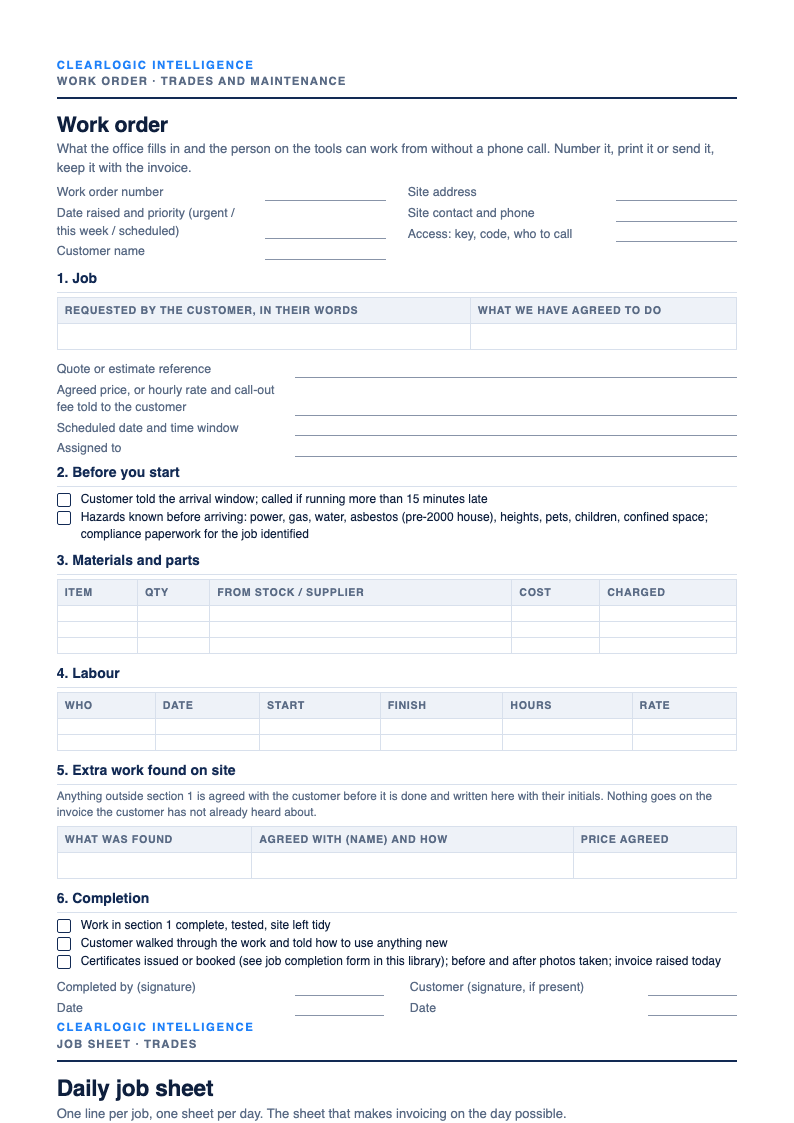
A work order the office fills and the person on the tools works from (job, access, hazards, materials, labour, extras agreed on site, completion), plus a daily job sheet with one line per job. Free, no email required.
What is a work order and how do you use one?
A work order is the instruction for one job: who the customer is, how to get in, what was agreed and at what price, what parts are needed, what hazards are known, and what counts as done. It is numbered, it travels with the job, and it ends up stapled to the invoice. The daily job sheet is the other half: one line per job per day with times, materials and whether a return visit is needed, so invoicing can happen the same day instead of at month end. Across 20,286 publicly posted NZ trade reviews, punctuality is praised in 40 to 44% of positive reviews and responsiveness in 20 to 38%. Both depend on the office knowing where everyone is and what is next, which is what these two pages record.
The job this document is doing.
- —The tradesperson arrives and rings the office to ask what the job actually is
- —An extra agreed on site on Tuesday is remembered differently on Friday, by both sides
- —Materials used on a job are reconstructed from memory a fortnight later for the invoice
- —A return visit is needed and nobody wrote it down, so the customer rings to ask
Open it and use it today.
- 01Work order: job in the customer’s words and what was agreed, quote reference, agreed price or rates told to the customer, before-you-start checks, materials and labour tables, extras agreed on site with the customer’s initials, completion checks, signatures
- 02Daily job sheet: six job lines with arrived, left, hours, materials, done or return visit, invoiced; notes for the office
- 03Editable Word version of both
Free to use and adapt for your own business. Not legal advice: check contract terms against your own terms of trade and, where it matters, with a lawyer.
Why this document, and not another one.
| Trade | Punctuality praised | Responsiveness praised | Not turning up, negative reviews |
|---|---|---|---|
| Plumbers | 44.2% of positive reviews | 38.0% | About 4% |
| Electricians | 41.9% of positive reviews | 34.5% | About 5% |
| Painters | 39.7% of positive reviews | 20.4% |
From 20,286 publicly posted reviews of 369 NZ electricians, plumbers and painters, collected August 2026. Positive reviews score 80 or more out of 100. Negative reviews score under 50 on any dimension; those samples are small (56 to 167 reviews), so negative-review figures are rounded and reported as rank order, not precision. Full corpus, method and thresholds: the trades methodology page. Full findings: the trades research study.
The questions this document answers, in full.
What Is a Work Order and How Do You Use One? (Trades Guide)
Read the answer →How to Keep Track of Jobs as a Tradie (Without a New App)
Read the answer →Use it alongside
Job completion and sign-off form
A two-page completion form (work done, extras, testing and compliance certificates, site, customer sign-off, follow-up) and a one-page practical completion and defects form for staged jobs.
Open this resource →A template fixes one document. The diagnostic finds the rest.
Seven minutes, results immediately: five pillars scored, your leaks quantified in dollars.
Start Diagnostic — $249