
Petty cash register in Excel, with printable vouchers and a count sheet: the tin reconciles to the cent every month.
An imprest-style register with a running balance, GST calculated where a receipt is held, a count and reconciliation sheet, and a PDF of vouchers and the monthly count. Free, no email required.
How do you manage petty cash in a small business?
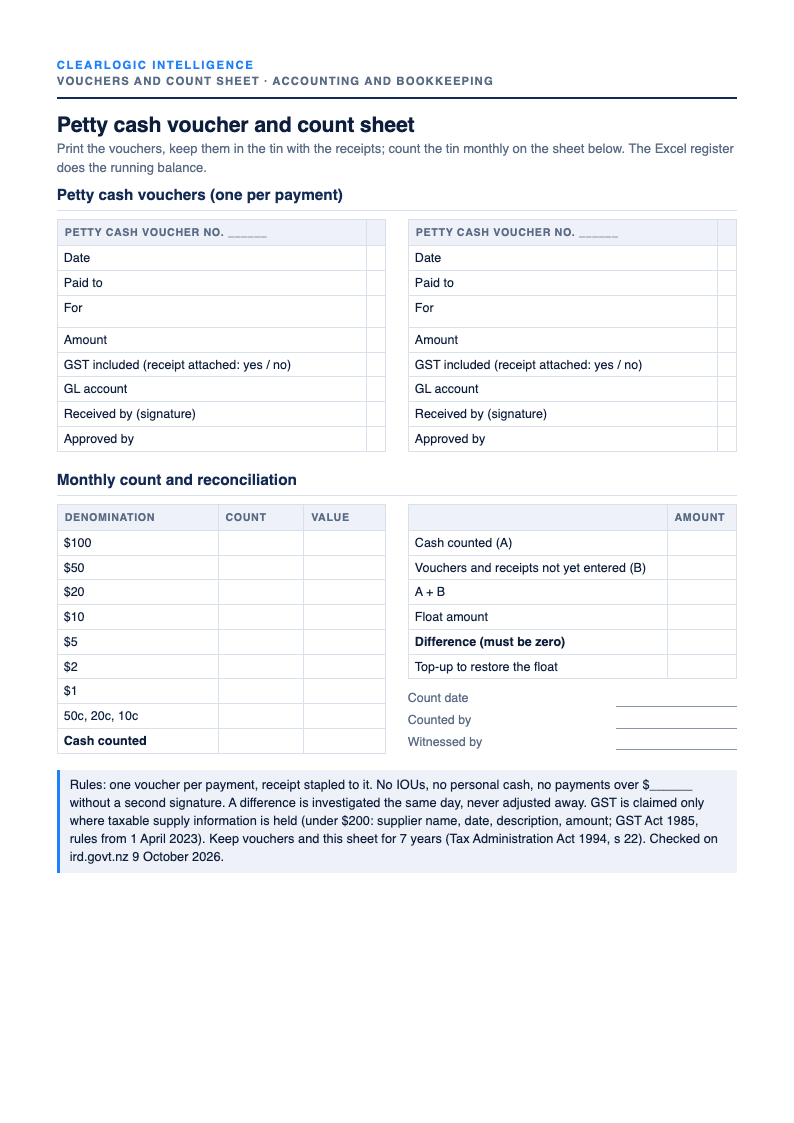
Use an imprest float: a fixed amount, say $200, that is topped up by exactly what was spent, so the cash in the tin plus the receipts always equals the float. Every payment gets a numbered voucher with the receipt stapled to it and a ledger account; no IOUs, no personal cash, a second signature over a set amount. Count the tin monthly against the register, investigate any difference the same day and never adjust it away. GST can be claimed only where taxable supply information is held; for purchases under $200 the supplier’s name, the date, a description and the amount are enough (GST Act 1985, rules from 1 April 2023). Keep the register, vouchers and receipts for 7 years (Tax Administration Act 1994, section 22). Across 6,190 positive publicly posted reviews of NZ accounting and bookkeeping practices, accuracy is praised in only 9%: clients assume it. Petty cash is where the assumption is quietly tested.
The job this document is doing.
- —The tin is $37 short and has been for months, and nobody can say since when
- —GST is claimed on receipts that do not show the supplier’s details
- —Petty cash is used for a $600 purchase that should have gone through accounts payable
- —The float is topped up to a round number instead of by what was spent, so it never reconciles
Open it and use it today.
- 01Register: date, voucher, paid to, description, ledger account, receipt attached, money in and out, GST (3/23 where a receipt is held), running balance (amber below 20% of the float), rows without a receipt turn red
- 02Count and reconcile sheet: denominations, cash counted plus vouchers not yet entered, difference (red if not zero), top-up required
- 03PDF: two vouchers per page, monthly count and reconciliation, the rules box
- 04How to use, with the GST and 7-year rules
Free to use and adapt for your own business. Not legal advice: check contract terms against your own terms of trade and, where it matters, with a lawyer.
The law behind it. Goods and Services Tax Act 1985, sections 19E to 19K (taxable supply information, from 1 April 2023); Tax Administration Act 1994, section 22 (7-year records). Checked on ird.govt.nz on 9 October 2026.
Why this document, and not another one.
| Measure (NZ accounting and bookkeeping) | Figure |
|---|---|
| Accuracy praised, positive reviews | 8.9% |
| Errors or mistakes mentioned, negative reviews | Under 1% |
| Clear explanation praised, positive reviews | 26.3% |
From 7,571 publicly posted customer reviews of 484 NZ accounting and bookkeeping practices, collected October 2026. Each review carries a single star rating: 4 or 5 stars counted as positive (n=6,190), 2 stars or fewer as negative (n=328, reported as rank order rather than precision, so negative-review figures are rounded). Praise and complaint traits were coded against a fixed taxonomy; no business is named. Full corpus, method and thresholds: the accounting & bookkeeping methodology page. Full findings: the accounting & bookkeeping research study.
Use it alongside
Monthly bookkeeping checklist (PDF and Excel)
Nineteen weekly, monthly, GST-period, quarterly and annual tasks with the Inland Revenue dates built in, a signed month-close line, and an Excel tracker that holds twelve months on one sheet with red-until-cleared cells.
Open this resource →A template fixes one document. The diagnostic finds the rest.
Seven minutes, results immediately: five pillars scored, your leaks quantified in dollars.
Start Diagnostic — $249