
Hourly rate calculator for NZ tradies: what your hour has to earn, markup versus margin, and your break-even.
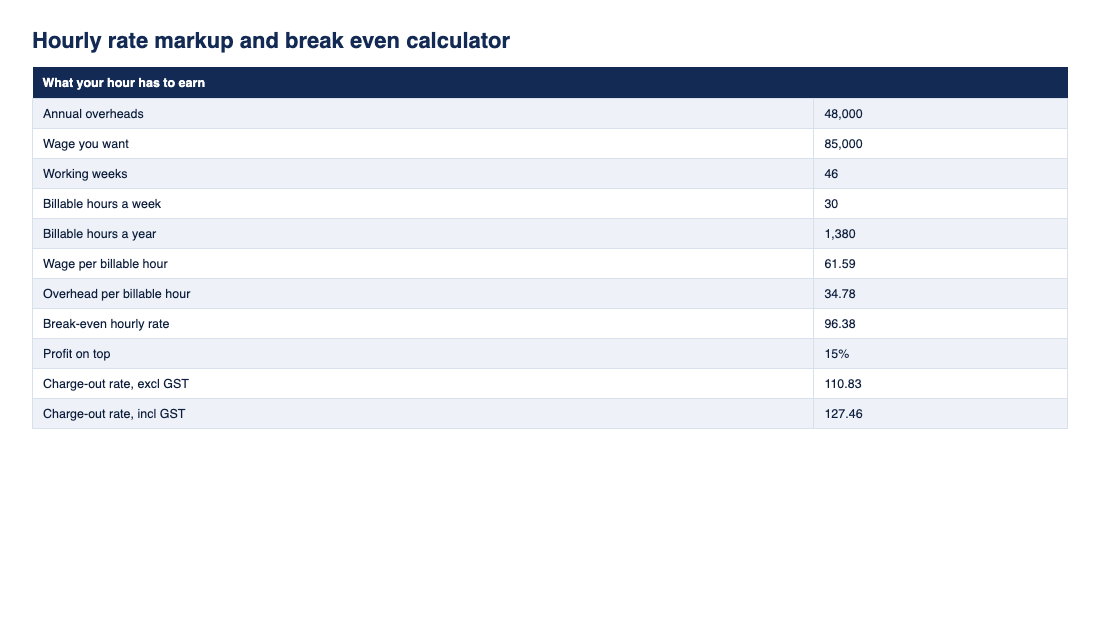
Type in your overheads, the wage you want and the hours you can really bill. It gives you the break-even rate, the charge-out rate with profit on top, what your markup is as a margin, and how many hours a month you must bill before anything is profit. Runs on the page; the Excel download has the same formulas. Free, no email required.
How do you work out an hourly rate as a tradie in NZ?
Add up what the business costs to run for a year (vehicle, insurance, tools, phone, software, accountant, advertising, rent) and the wage you want to pay yourself. Divide that by the hours you can actually bill, not the hours you work: most one-person trade businesses bill 25 to 32 hours a week once quoting, travel, admin and chasing payment are taken out, over about 46 working weeks. That is your break-even rate. Put profit on top, and that is the charge-out rate. Then check markup against margin: markup is on cost and margin is on price, so a 35% markup is a 25.9% margin, and a 30% margin needs a 42.9% markup. Across 20,286 publicly posted NZ trade reviews, value is the lowest-scoring of the four rated dimensions for every trade and quote accuracy is praised in only 7 to 11% of positive reviews. The number most tradies get wrong is not the price. It is the hours they divided by.
Your charge-out rate, from your own numbers.
Your numbers
What your hour has to earn
Markup and margin
Break-even
What it works out to
Runs in your browser; nothing you type is stored or sent anywhere. The Excel download carries the same formulas, so the two always agree.
The job this document is doing.
- —The rate was set by asking what the bloke down the road charges, so it recovers his overheads, not yours
- —Forty hours a week went into the sum, but only 28 of them were ever billed
- —A 30% markup was quoted to the accountant as a 30% margin, and the year-end profit came in a third short
- —Nobody knew how many hours a month had to be billed before the business made a cent, so a quiet month looked like bad luck
Open it and use it today.
- 01Hourly rate: overheads, wage, working weeks and billable hours in; wage per hour, overhead per hour, break-even rate and charge-out rate (excl and incl GST) out
- 02Markup and margin: converts either way, with a reference table from 10% to 100% markup
- 03Break-even: fixed costs a month, the hours to bill to cover them, per week, and the jobs that takes at your average job value
- 04Excel workbook with the same three sheets and formulas, shaded cells for your inputs, and a how-to sheet
- 05Nothing you type is sent anywhere; the calculator runs in your browser
Free to use and adapt for your own business. An estimate for planning, not accounting advice: check the rate against your own accounts and your accountant.
Why this document, and not another one.
| Trade | Quote accuracy praised | Value score (of 4 dimensions) | Quality score minus value score |
|---|---|---|---|
| Plumbers | 6.7% of positive reviews | 95.5 / 100 (lowest) | 2.7 points |
| Electricians | 6.8% of positive reviews | 97.1 / 100 (lowest) | 1.9 points |
| Painters | 11.1% of positive reviews | 97.8 / 100 (lowest) |
From 20,286 publicly posted reviews of 369 NZ electricians, plumbers and painters, collected August 2026. Positive reviews score 80 or more out of 100. Negative reviews score under 50 on any dimension; those samples are small (56 to 167 reviews), so negative-review figures are rounded and reported as rank order, not precision. Full corpus, method and thresholds: the trades methodology page. Full findings: the trades research study.
The questions this document answers, in full.
How Much Should a Call-Out Fee Be in NZ? (And How to Tell Customers)
Read the answer →How to Set a Tradie Hourly Rate in NZ (The Sum Most People Skip)
Read the answer →How to Price a Job as a Tradie in NZ (Cost It First)
Read the answer →Markup vs Margin for Trades: The Difference That Costs You Money
Read the answer →Use it alongside
Job costing and markup sheet with estimate template
Three working sheets (job costing with overhead recovery, what your hour must earn, markup versus margin) and a printable estimate with exclusions and terms.
Open this resource →A template fixes one document. The diagnostic finds the rest.
Seven minutes, results immediately: five pillars scored, your leaks quantified in dollars.
Start Diagnostic — $249