
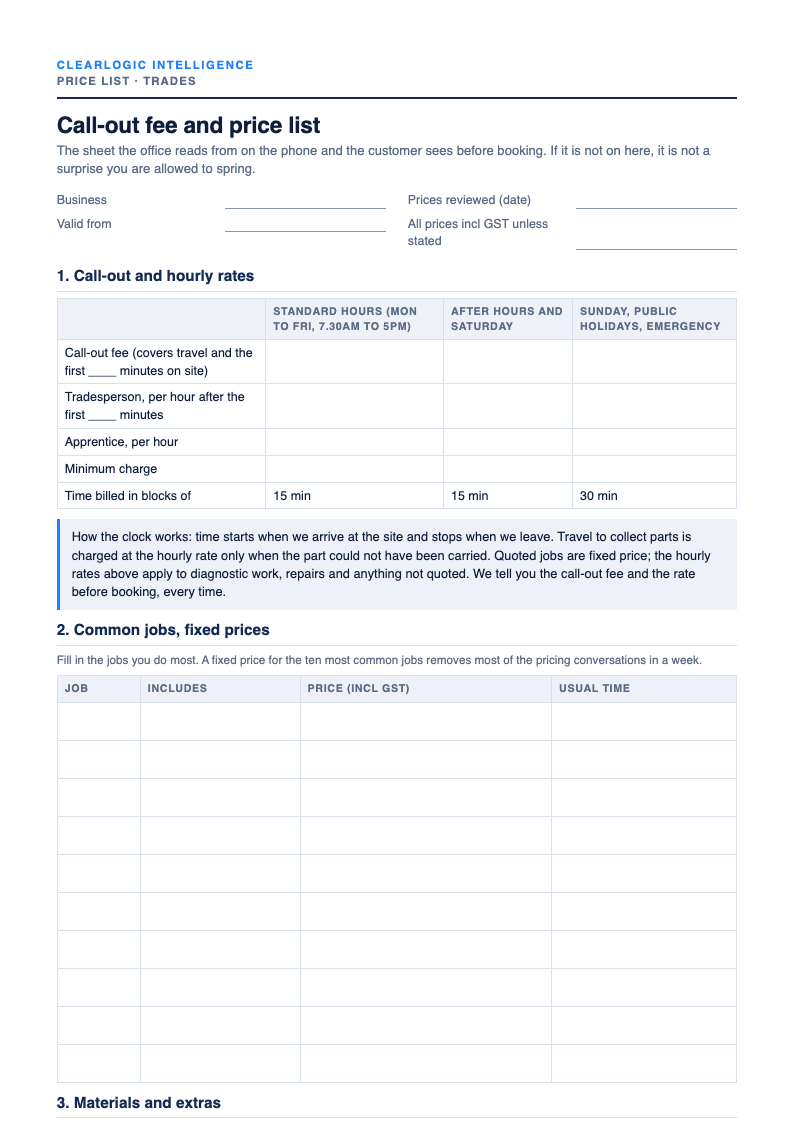
Call-out fee and price list sheet: the rates the office reads from on the phone, and the customer sees before booking.
A two-page printable price list (call-out, hourly and after-hours rates, how the clock works, ten fixed-price jobs, materials and extras) and an Excel sheet that calculates the rates from your cost per hour. Free, no email required.
How much should a call-out fee be in NZ?
A call-out fee covers travel and the first block of time on site, so it should recover what that costs you: usually three quarters of an hour to an hour at your charge-out rate, higher after hours. What matters more than the number is that the customer hears it before booking, along with the hourly rate, when the clock starts and stops, and how parts are charged. Prices shown to customers must be accurate and not misleading under the Fair Trading Act 1986; a call-out fee that first appears on the invoice is exactly the conduct it is written for. Across 20,286 publicly posted NZ trade reviews, overcharging is the top complaint theme in negative reviews (about 7% for electricians and plumbers) while transparent pricing is praised in about 23% of positive reviews. Same sheet, both outcomes.
The job this document is doing.
- —The call-out fee is mentioned for the first time on the invoice
- —Nobody can say whether travel to collect a part is charged, so sometimes it is and sometimes it is not
- —The ten most common jobs get priced from scratch every time, differently each time
- —After-hours rates exist in the owner’s head and nowhere else
Open it and use it today.
- 01Rates table: call-out fee, tradesperson and apprentice hourly rates, minimum charge, billing blocks, for standard, after-hours and Sunday or public holiday
- 02How the clock works, in one box
- 03Ten fixed-price common jobs with what is included and usual time
- 04Materials, disposal, council fees, late cancellation and payment terms
- 05Excel: rates calculated from cost per hour, margin and loadings; a price list sheet with materials markup and GST
Free to use and adapt for your own business. Not legal advice: check contract terms against your own terms of trade and, where it matters, with a lawyer.
The law behind it. Fair Trading Act 1986 (misleading representations about price). Checked on legislation.govt.nz on 9 October 2026.
Why this document, and not another one.
| Trade | Overcharging, negative reviews | Vague quotes, negative reviews | Transparent pricing praised |
|---|---|---|---|
| Plumbers | About 7% (top complaint theme) | 22.7% of positive reviews | |
| Electricians | About 7% (top complaint theme) | About 2% | 22.6% of positive reviews |
From 20,286 publicly posted reviews of 369 NZ electricians, plumbers and painters, collected August 2026. Positive reviews score 80 or more out of 100. Negative reviews score under 50 on any dimension; those samples are small (56 to 167 reviews), so negative-review figures are rounded and reported as rank order, not precision. Full corpus, method and thresholds: the trades methodology page. Full findings: the trades research study.
The questions this document answers, in full.
How Much Should a Call-Out Fee Be in NZ? (And How to Tell Customers)
Read the answer →How to Set a Tradie Hourly Rate in NZ (The Sum Most People Skip)
Read the answer →Use it alongside
Job costing and markup sheet with estimate template
Three working sheets (job costing with overhead recovery, what your hour must earn, markup versus margin) and a printable estimate with exclusions and terms.
Open this resource →A template fixes one document. The diagnostic finds the rest.
Seven minutes, results immediately: five pillars scored, your leaks quantified in dollars.
Start Diagnostic — $249