
13-week cash flow forecast template in Excel: see the overdrawn week six weeks before it arrives.
A rolling 13-week forecast with six receipt lines, twelve payment lines, a minimum-balance threshold and an assumptions sheet. Closing balances turn amber below your minimum and red below zero. Free, no email required.
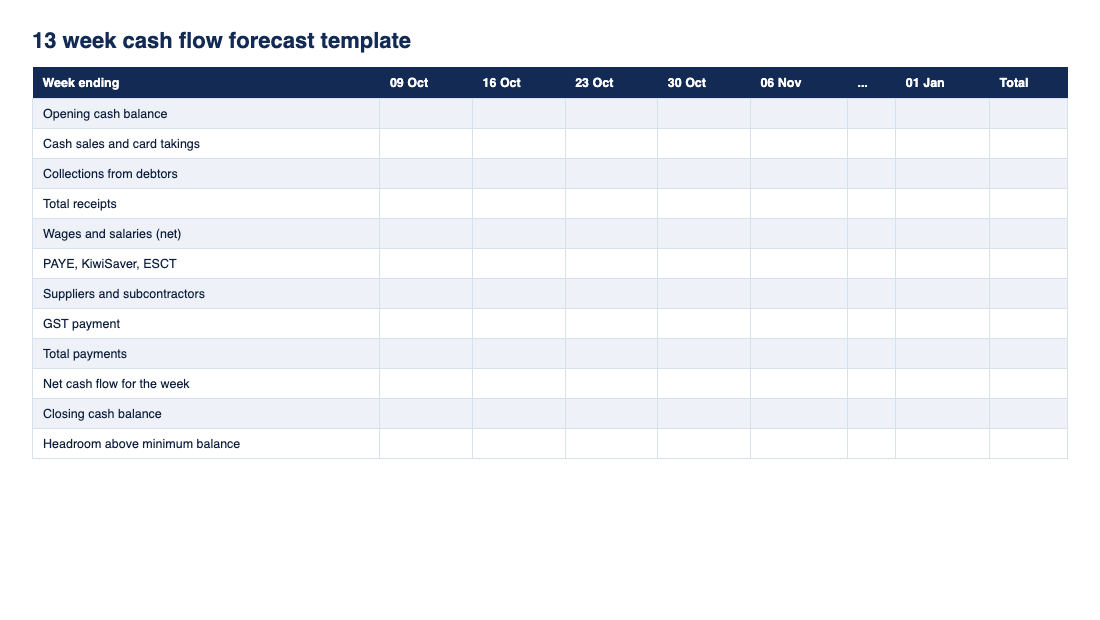
How do you build a 13-week cash flow forecast?
Put this week’s bank balance at the top, list what cash will actually arrive each week (takings, debtor collections, refunds) and what will actually leave (wages, PAYE, suppliers, rent, loan payments, GST, provisional tax, drawings), and carry the closing balance into the next week’s opening balance. Thirteen weeks is long enough to see a tax date coming and short enough to be honest about. Each Monday, replace last week’s forecast with actuals and add a new week at the end. In 6,190 positive publicly posted reviews of NZ accounting and bookkeeping practices, proactive advice is praised in 42.2% and problem solving in 15.9%. A forecast handed to a client before a tax date is both.
The job this document is doing.
- —The GST bill and the provisional tax instalment land in the same fortnight as a quiet month, and nobody saw it
- —Debtor collections are forecast at invoice value, not at what actually gets paid
- —The forecast was built once in January and has not been touched since
- —The accountant hears about the cash problem after the bank does
Open it and use it today.
- 0113 weekly columns with dates that follow from one cell, plus a 13-week total
- 02Six receipt lines and twelve payment lines matched to how NZ small businesses actually pay out: wages and PAYE separately, GST, provisional tax, drawings
- 03Opening and closing balances linked week to week; net cash flow and headroom above your minimum
- 04Amber and red flags on closing balances; an assumptions sheet with a source and last-checked column
- 05How to use, including the Monday roll-forward routine
Free to use and adapt for your own business. Not legal advice: check contract terms against your own terms of trade and, where it matters, with a lawyer.
Why this document, and not another one.
| Measure (NZ accounting and bookkeeping) | Figure | Rank among 11 praised traits |
|---|---|---|
| Proactive advice praised, positive reviews | 42.2% | 4th |
| Accessibility (easy to reach) praised | 42.5% | 3rd |
| Problem solving praised, positive reviews | 15.9% | 8th |
From 7,571 publicly posted customer reviews of 484 NZ accounting and bookkeeping practices, collected October 2026. Each review carries a single star rating: 4 or 5 stars counted as positive (n=6,190), 2 stars or fewer as negative (n=328, reported as rank order rather than precision, so negative-review figures are rounded). Praise and complaint traits were coded against a fixed taxonomy; no business is named. Full corpus, method and thresholds: the accounting & bookkeeping methodology page. Full findings: the accounting & bookkeeping research study.
Use it alongside
Monthly bank reconciliation template (Excel)
A three-sheet workbook: the reconciliation itself, an outstanding-items list that feeds it, and a 12-month sign-off checklist.
Open this resource →A template fixes one document. The diagnostic finds the rest.
Seven minutes, results immediately: five pillars scored, your leaks quantified in dollars.
Start Diagnostic — $249