
Practical completion certificate, defects schedule and pre-handover inspection checklist (NZ).
Three pages: the certificate (who issues it, what it triggers, the documents the Building Act requires at handover), a defects and omissions schedule with owners and dates, and a 15-area inspection checklist to walk the day before the client does. PDF and editable Word. Free, no email required.
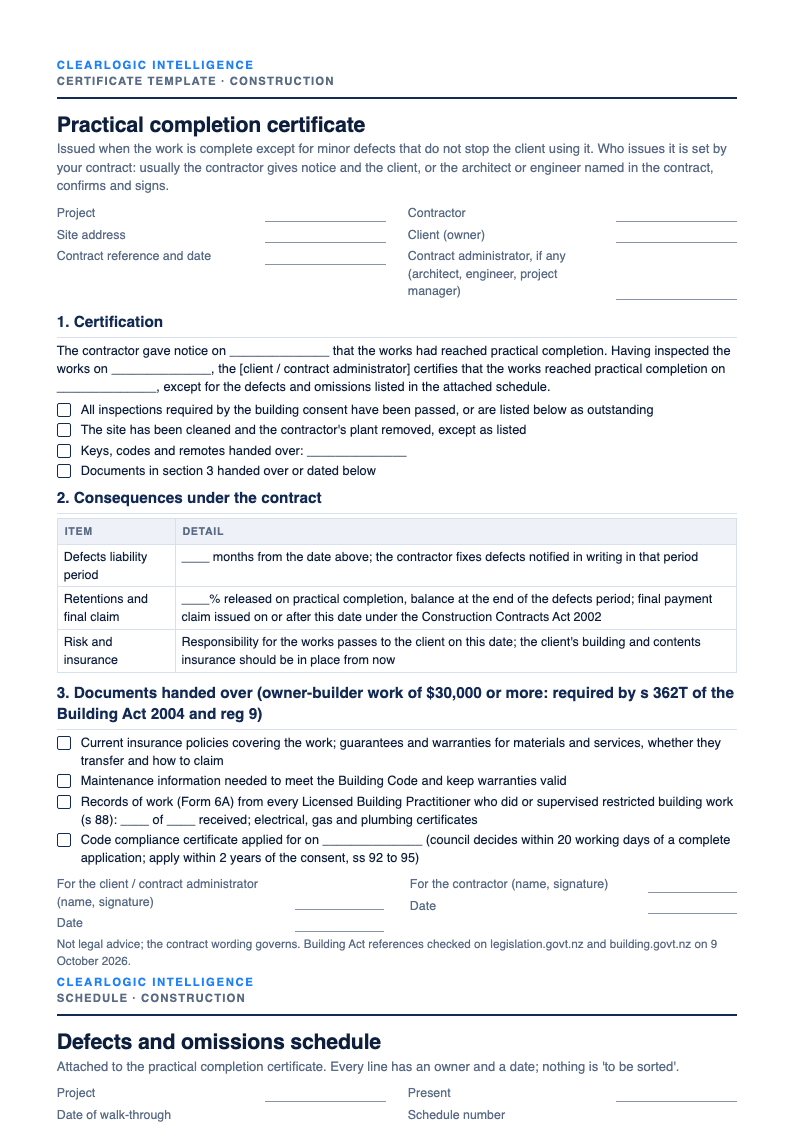
What is practical completion, and who issues the certificate in NZ?
Practical completion is the point where the work is complete except for minor defects that do not stop the client using it. It is not defined in the Building Act; your contract defines it and says who certifies it. Usually the contractor gives notice, and the client, or the architect, engineer or project manager named in the contract, inspects and signs. The date starts the defects liability period, releases the first part of any retentions and allows the final payment claim. For residential work of $30,000 or more, section 362T of the Building Act 2004 requires the contractor to hand over insurance policies, guarantees and warranties, and maintenance information on completion; Licensed Building Practitioners must give a record of work for restricted building work (section 88); and the code compliance certificate is applied for under sections 92 to 95 (the council decides within 20 working days of a complete application). Across 13,567 publicly posted NZ construction reviews, clear explanation is praised in 34 to 41% of positive reviews and a follow-up after the job in about 2%. The handover is the explanation; the follow-up visit a month later is what almost nobody does.
The job this document is doing.
- —‘Practically complete’ is announced verbally and the final payment is argued about for months
- —Records of work are chased at code compliance time from a sub who has moved on
- —The defects list lives in an email thread with no dates, so items are still open at Christmas
- —The client finds the leaking shower on day one because nobody ran the taps before handover
Open it and use it today.
- 01Certificate: notice and inspection dates, the certification wording, consequences table (defects period, retentions and final claim, risk and insurance), documents handed over checklist with the Building Act references
- 02Defects and omissions schedule: 12 lines with location, agreed fix, by-date, fixed-on and client initial
- 03Pre-handover inspection: 15 areas from cladding and gutters to switchboard labels and protective film
- 04Editable Word version
Free to use and adapt for your own business. Not legal advice: check contract terms against your own terms of trade and, where it matters, with a lawyer.
The law behind it. Building Act 2004, sections 88 (record of work), 92 to 95 (code compliance certificate) and 362T with regulation 9 (information at completion); Construction Contracts Act 2002 (final claim, retentions). Checked on legislation.govt.nz and building.govt.nz on 9 October 2026. The contract wording governs.
Why this document, and not another one.
| Category | Clear explanation praised | Aftercare or follow-up praised | Referral language in positive reviews |
|---|---|---|---|
| Builders | 40.7% of positive reviews | 2.2% | 62.4% |
| Outdoor and civil construction | 34.2% of positive reviews | 1.9% | 62.7% |
From 13,567 publicly posted reviews of 328 NZ builders and outdoor and civil construction contractors, collected August 2026. Positive reviews score 80 or more out of 100. Full corpus, method and thresholds: the construction methodology page. Full findings: the construction research study.
The questions this document answers, in full.
What to Check at Building Handover in NZ (Owner and Builder Checklist)
Read the answer →What Is Practical Completion in NZ? (And Why It Is Not the CCC)
Read the answer →Use it alongside
Residential building contract template and mandatory-content checklist
A five-page contract as PDF and editable Word file: the work, price, payment claims, dates, variations, each party’s responsibilities, defects, ending early, disputes, a Schedule A of exclusions, and the mandatory-content checklist.
Open this resource →A template fixes one document. The diagnostic finds the rest.
Seven minutes, results immediately: five pillars scored, your leaks quantified in dollars.
Start Diagnostic — $249