
Year-end client information request list (NZ): sixteen things to ask every client in April, and an Excel tracker that shows who has sent what.
A one-page request list for a 31 March balance date (bank, debtors, creditors, stock, assets, vehicles, home office, payroll, GST, drawings, income not in the bank, entities, Inland Revenue, questions) with sent and received columns, plus a tracker across all your clients. Free, no email required.
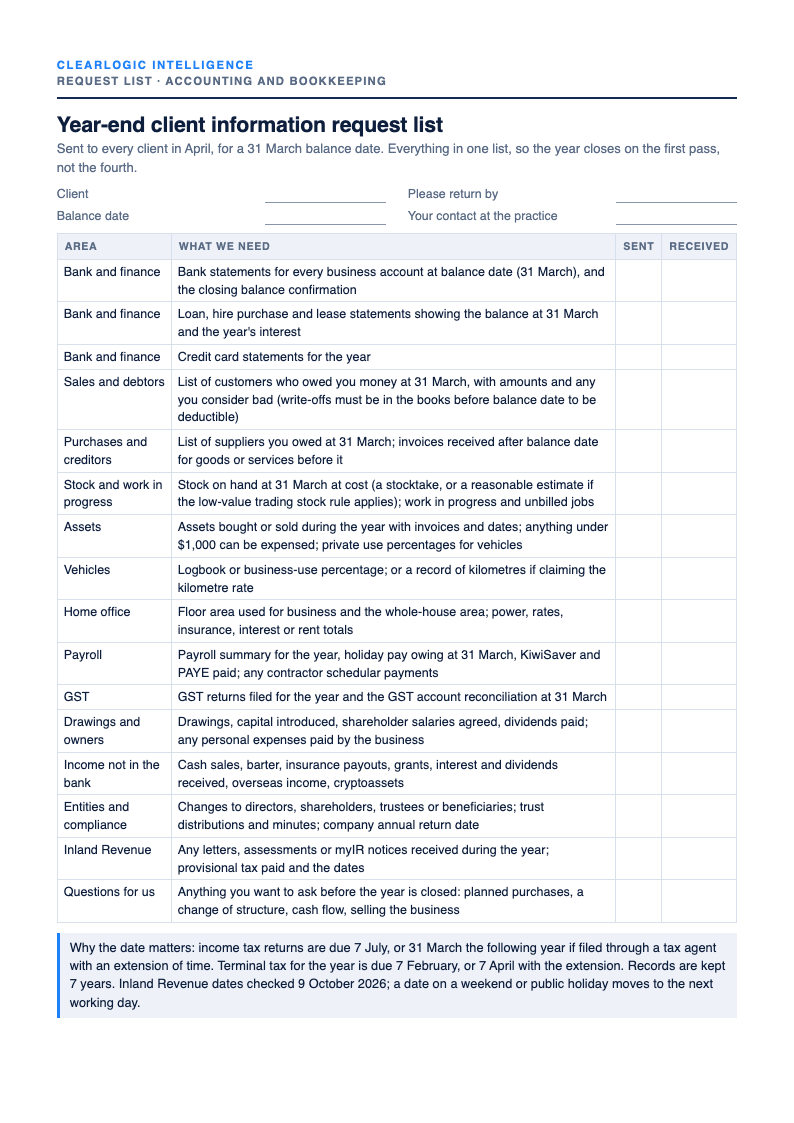
What do accountants need from clients for year end in NZ?
Bank, loan and card statements showing the 31 March balances; who owed the client and who they owed at balance date, with any bad debts actually written off before 31 March (that is when they become deductible); stock on hand at cost and work in progress; assets bought and sold with invoices (under $1,000 can be expensed); vehicle and home office use; payroll summaries and holiday pay owing; the GST reconciliation; drawings, capital and shareholder salaries; income that never touched the bank; changes to directors, trustees or shareholders; every Inland Revenue letter; and the questions the client wants answered before the year closes. Returns are due 7 July, or 31 March the following year through a tax agent with extension of time; terminal tax 7 February or 7 April. Across 6,190 positive publicly posted reviews of NZ accounting and bookkeeping practices, deadline reliability is praised in only 3% while proactive advice is praised in 42%. A list sent in April is the first proactive thing the client sees each year.
The job this document is doing.
- —The client sends the bank statements, then the loan statement, then the stock figure, over three months of emails
- —A bad debt is written off in May and the deduction is lost
- —A vehicle bought in February turns up at the following year end
- —The question the client wanted to ask (selling the business) comes up after the return is filed
Open it and use it today.
- 01Request list: 16 items grouped by area, in the client’s language, with sent and received columns and the return-by date
- 02The dates box: 7 July and 31 March returns, 7 February and 7 April terminal tax, 7-year records
- 03Excel tracker: one row per client, Yes / No / N/A / Chased per item, complete flag, return filed date, chase filter
Free to use and adapt for your own business. Not legal advice: check contract terms against your own terms of trade and, where it matters, with a lawyer.
The law behind it. Inland Revenue due dates for income tax returns and terminal tax (31 March balance date); Income Tax Act 2007 (bad debts section DB 31; low-value asset threshold $1,000); Tax Administration Act 1994, section 22. Checked on ird.govt.nz on 9 October 2026.
Why this document, and not another one.
| Measure (NZ accounting and bookkeeping) | Figure |
|---|---|
| Deadline reliability praised, positive reviews | 3.1% |
| Proactive advice praised, positive reviews | 42.2% |
| Responsiveness praised, positive reviews | 29.4% |
| Unresponsive, negative reviews | About 4% |
From 7,571 publicly posted customer reviews of 484 NZ accounting and bookkeeping practices, collected October 2026. Each review carries a single star rating: 4 or 5 stars counted as positive (n=6,190), 2 stars or fewer as negative (n=328, reported as rank order rather than precision, so negative-review figures are rounded). Praise and complaint traits were coded against a fixed taxonomy; no business is named. Full corpus, method and thresholds: the accounting & bookkeeping methodology page. Full findings: the accounting & bookkeeping research study.
Use it alongside
NZ tax and compliance deadline calendar 2026/27 (PDF and Excel)
GST, PAYE, FBT, provisional and terminal tax and return dates from April 2026 to March 2027, each shown with the working-day date it moves to when it falls on a weekend or public holiday, plus the first dates of 2027/28 and an Excel version with days-to-go flags.
Open this resource →A template fixes one document. The diagnostic finds the rest.
Seven minutes, results immediately: five pillars scored, your leaks quantified in dollars.
Start Diagnostic — $249