
Job costing and markup sheet in Excel, with a one-page estimate template: the price that still makes money when the job is done.
Three working sheets (job costing with overhead recovery, what your hour must earn, markup versus margin) and a printable estimate with exclusions and terms. Free, no email required.
How do you price a job as a tradie in NZ?
Start from what an hour actually costs you: overheads plus the wage you want, divided by the hours you can really bill in a year. Most one-person trade businesses bill 25 to 32 hours a week, not 40. Then cost the job line by line (labour hours, materials, subs, plant, consumables, disposal, permits), recover overhead on every labour hour, and apply markup to reach the margin you want. Markup is on cost; margin is on price; 35% markup is a 25.9% margin. Across 20,286 publicly posted NZ trade reviews, value is the lowest-scoring of the four rated dimensions for every trade and quote accuracy is praised in only 7 to 11% of positive reviews. Jobs are rarely undercut by a competitor. They are undercosted by the person quoting.
The job this document is doing.
- —The hourly rate was set by asking what the bloke down the road charges
- —Travel, consumables and the skip never make it onto the costing, so every job is 8% thinner than it looks
- —Materials marked up 10% on a job where materials are 70% of the price
- —The estimate has no exclusions, so the first surprise behind the wall is a free one
Open it and use it today.
- 01Job costing sheet: 12 cost lines, overhead recovered per labour hour, target markup set once and overridable per line, margin flagged red under 20% and amber under 30%, GST and price to quote
- 02Hourly rate sheet: overheads, wage, working weeks, billable hours, break-even and charge-out rate
- 03Markup versus margin table and the formula to convert one to the other
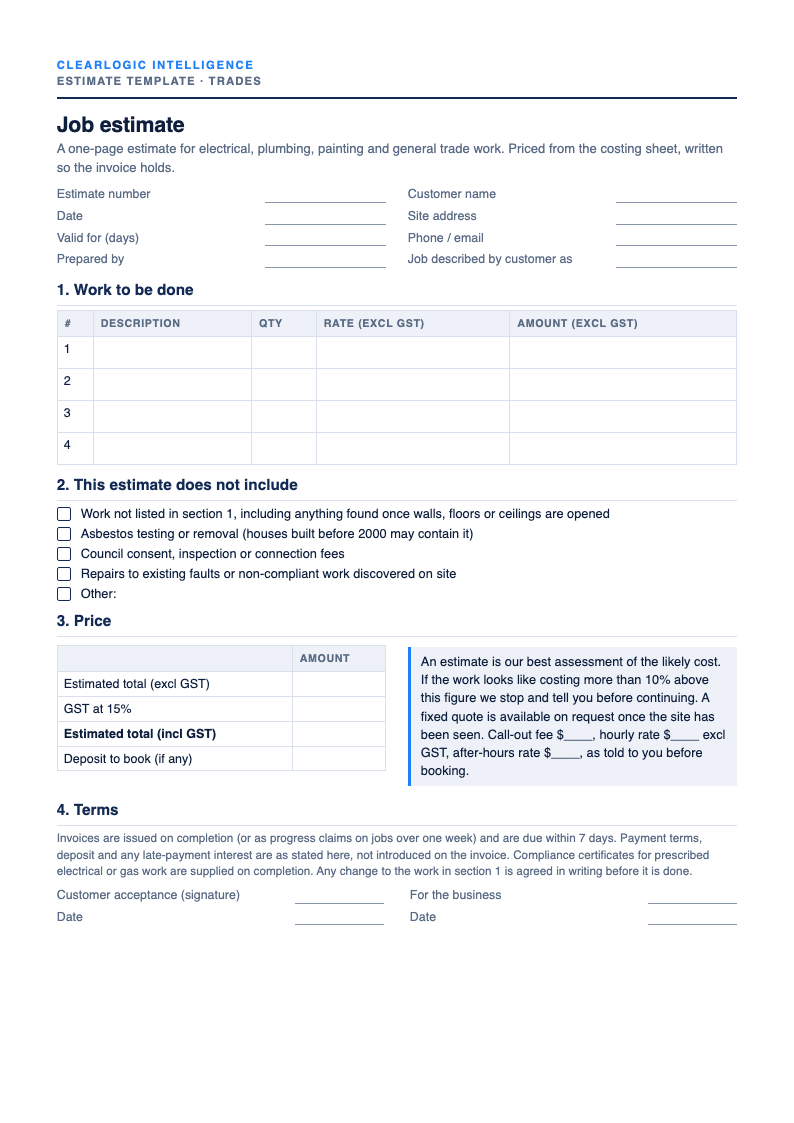
- 04Estimate PDF: work lines, exclusions checklist (asbestos, consents, existing faults), price, the 10% stop-and-tell rule, call-out and hourly rate disclosure, acceptance
Free to use and adapt for your own business. Not legal advice: check contract terms against your own terms of trade and, where it matters, with a lawyer.
Why this document, and not another one.
| Trade | Quote accuracy praised | Value score (of 4 dimensions) | Quality score minus value score |
|---|---|---|---|
| Plumbers | 6.7% of positive reviews | 95.5 / 100 (lowest) | 2.7 points |
| Electricians | 6.8% of positive reviews | 97.1 / 100 (lowest) | 1.9 points |
| Painters | 11.1% of positive reviews | 97.8 / 100 (lowest) |
From 20,286 publicly posted reviews of 369 NZ electricians, plumbers and painters, collected August 2026. Positive reviews score 80 or more out of 100. Negative reviews score under 50 on any dimension; those samples are small (56 to 167 reviews), so negative-review figures are rounded and reported as rank order, not precision. Full corpus, method and thresholds: the trades methodology page. Full findings: the trades research study.
The questions this document answers, in full.
How to Price a Job as a Tradie in NZ (Cost It First)
Read the answer →Markup vs Margin for Trades: The Difference That Costs You Money
Read the answer →Use it alongside
Call-out fee and price list sheet
A two-page printable price list (call-out, hourly and after-hours rates, how the clock works, ten fixed-price jobs, materials and extras) and an Excel sheet that calculates the rates from your cost per hour.
Open this resource →A template fixes one document. The diagnostic finds the rest.
Seven minutes, results immediately: five pillars scored, your leaks quantified in dollars.
Start Diagnostic — $249