
NZ tax and compliance deadline calendar 2026/27, PDF and Excel: every Inland Revenue date for a 31 March balance date, with the ones that move.
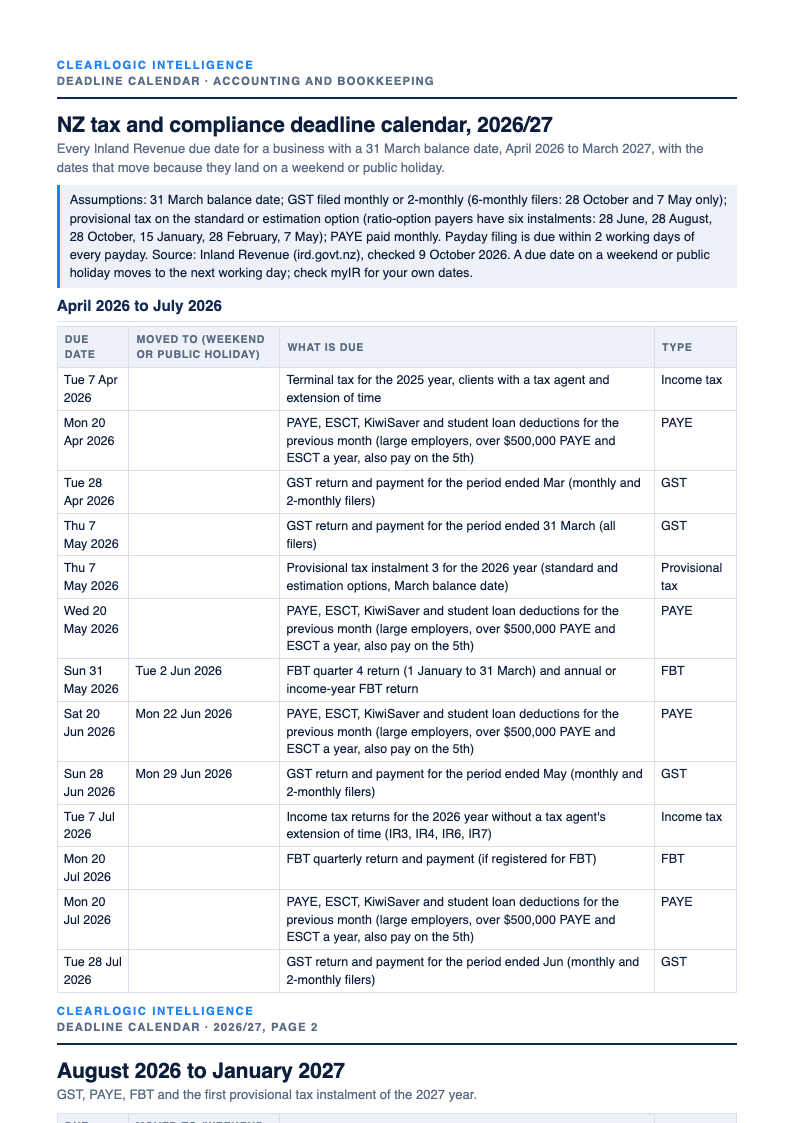
GST, PAYE, FBT, provisional and terminal tax and return dates from April 2026 to March 2027, each shown with the working-day date it moves to when it falls on a weekend or public holiday, plus the first dates of 2027/28 and an Excel version with days-to-go flags. Free, no email required.
When is provisional tax due in NZ, and what are the other dates?
For a 31 March balance date on the standard or estimation option, provisional tax is due 28 August, 15 January and 7 May; ratio-option payers have six instalments. GST is due on the 28th of the month after the period, except the March period (7 May) and the November period (15 January). PAYE and KiwiSaver are due on the 20th of the following month, or the 5th and 20th for employers over $500,000 of PAYE and ESCT a year, and every payday is filed within two working days. FBT quarters fall due 20 July, 20 October, 20 January and 31 May. Income tax returns are due 7 July, or 31 March the following year through a tax agent with extension of time; terminal tax 7 February, or 7 April with the extension. A date on a weekend or public holiday moves to the next working day, which is why terminal tax for 2026 lands on 9 February 2027. Across 6,190 positive publicly posted reviews of NZ accounting and bookkeeping practices, proactive advice is praised in 42% and deadline reliability in only 3%: clients notice the reminder, not the filing.
The job this document is doing.
- —The 20th falls on a Sunday and nobody knew whether that meant Friday or Monday
- —Terminal tax is diarised for 7 February, which is a Sunday followed by Waitangi Day observed
- —The client’s ratio-option dates are different and the practice calendar does not say so
- —The new KiwiSaver employer rate from 1 April is applied from the first pay run in May
Open it and use it today.
- 01Three-page PDF: the assumptions box, then every date April to September 2026, October 2026 to March 2027, and the first 2027/28 dates, each with the moved date where it applies
- 02Excel: statutory date, working-day date, what is due, type, applies-to-us, done, days to go (amber inside 14 days, red when missed)
- 03Source and date-checked line on every page; payday filing and the ratio option explained
Free to use and adapt for your own business. Not legal advice: check contract terms against your own terms of trade and, where it matters, with a lawyer.
The law behind it. Inland Revenue due dates (ird.govt.nz) and public holidays under the Holidays Act 2003, including Mondayised dates; KiwiSaver employer contribution 3.5% from 1 April 2026. Checked on 9 October 2026. Confirm your own dates in myIR.
Why this document, and not another one.
| Measure (NZ accounting and bookkeeping) | Figure | Rank among 11 praised traits |
|---|---|---|
| Proactive advice praised, positive reviews | 42.2% | 4th |
| Deadline reliability praised, positive reviews | 3.1% | 11th |
| Accessibility (easy to reach) praised | 42.5% | 3rd |
| Repeat-use language in positive reviews | 27.0% | 6th |
From 7,571 publicly posted customer reviews of 484 NZ accounting and bookkeeping practices, collected October 2026. Each review carries a single star rating: 4 or 5 stars counted as positive (n=6,190), 2 stars or fewer as negative (n=328, reported as rank order rather than precision, so negative-review figures are rounded). Praise and complaint traits were coded against a fixed taxonomy; no business is named. Full corpus, method and thresholds: the accounting & bookkeeping methodology page. Full findings: the accounting & bookkeeping research study.
Use it alongside
Year-end client information request list (PDF and Excel tracker)
A one-page request list for a 31 March balance date (bank, debtors, creditors, stock, assets, vehicles, home office, payroll, GST, drawings, income not in the bank, entities, Inland Revenue, questions) with sent and received columns, plus a tracker across all your clients.
Open this resource →A template fixes one document. The diagnostic finds the rest.
Seven minutes, results immediately: five pillars scored, your leaks quantified in dollars.
Start Diagnostic — $249